
Cover your next rollout peak without handing over design control
The Retail and QSR Design Capacity Playbook shows design leaders how to test outside production on one real package in 90 days. Your standards. Your review gates. Your stamp.
Get the free playbook- A boundary test for what stays in your studio and what a partner can produce
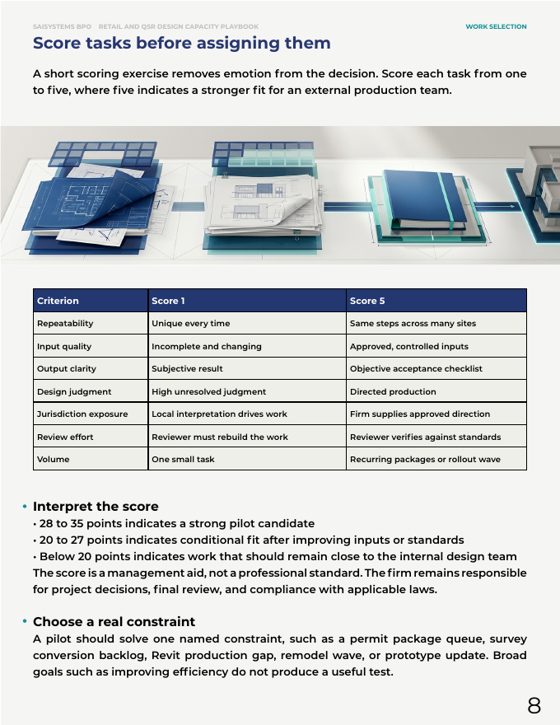
- A seven-criterion score to pick the right first pilot package
- Quality gates at 30, 60, and 90 percent so final review stops being first review
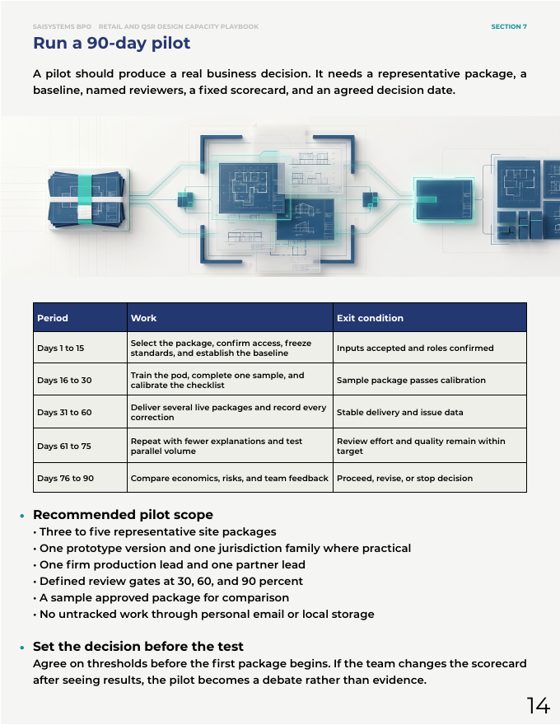
- A 90-day pilot plan and scorecard with proceed, revise, and stop thresholds
Written for architecture principals, design directors, studio leaders, and project delivery executives running multi-site retail and QSR programs.
Get the playbook
The architecture labor market is short and long at the same time
Firm leaders surveyed by the American Institute of Architects in May 2026 reported:
say recruiting architectural staff is a problem
are understaffed today
are hiring contract workers in response
Another 15 percent report being overstaffed. Hire for the peak and you carry the cost after the wave passes. Hire for the average and you carry the schedule risk during it.
Source: American Institute of Architects, Architecture Billings Index, May 2026
Retail and QSR programs release work in waves
A prototype approval, an acquisition, a remodel wave, or a permit resubmission cycle can drop dozens of packages on your studio in the same month. Permanent staff rarely match those peaks.
So senior people absorb the redlines. Reviews slide toward the deadline. Your design leaders lose the hours they need for client decisions, code strategy, and technical oversight.
The playbook reframes the question. Not whether you have enough people today, but whether your staffing model covers the next program peak without lowering review quality.
Signs capacity is already constraining design
- Project architects spend evenings incorporating redlines
- Senior reviews happen after client or permit deadlines are at risk
- Standards maintenance keeps getting postponed
- Proposal teams decline work because bandwidth is uncertain
- One departure puts several active programs at risk
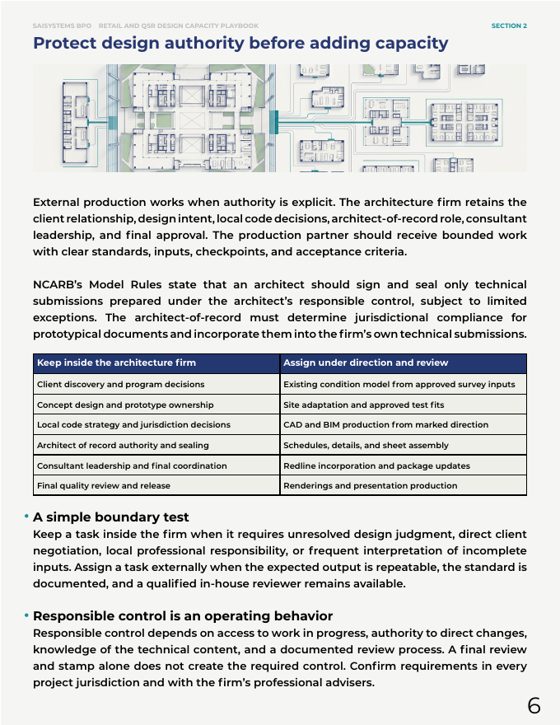
Draw the line before you add capacity
External production works when authority is explicit. The playbook gives you the split, the role matrix, and the handoff package that makes it hold.
Your firm keeps
- Client discovery and program decisions
- Concept design and prototype ownership
- Local code strategy and jurisdiction decisions
- Architect-of-record authority and sealing
- Final quality review and release
A governed production pod handles
- Existing condition models from approved survey inputs
- Site adaptation and approved test fits
- CAD and BIM production from marked direction
- Schedules, details, and sheet assembly
- Redline incorporation and package updates
The boundary test: keep a task inside when it needs unresolved design judgment, client negotiation, or local professional responsibility. Assign it out when the output is repeatable, the standard is documented, and a qualified reviewer in your firm stays available.
Ten sections, from capacity check to pilot decision
Built from AIA, NCARB, and National Restaurant Association research. Company results are labeled as company-reported.
Capacity pressure
Find where workload swings hit quality, margin, and delivery.
Design control
Separate professional judgment from repeatable production.
Work selection
Score tasks by phase and input quality before you assign them.
Production model
Set roles, inputs, cadence, and a handoff package that survives distance.
Quality system
Create gates, acceptance criteria, and correction ownership.
Capacity economics
Compare full internal cost with governed partner cost per accepted package.
Pilot plan
Test one real package over 90 days with exit conditions per phase.
Case evidence
Review a 98-site QSR kiosk floor plan program.
Partner evaluation
Nine areas and the questions that expose delivery discipline.
Readiness worksheet
Nine statements, 18 points. Proceed, prepare, or pause.
Working tools, not opinion
Tables you can lift straight into your next leadership meeting.
Governed production on a 98-site QSR rollout
A QSR kiosk program needed floor plans for 98 sites across San Diego, New York, and Canada. Existing plans had inconsistent dimensions, seating counts, and site data. Saisystems Technology organized the work in location-based phases, ran quality checks, and tracked delivery centrally.
completed across 3 regions in 19 days
improvement in turnaround time
fewer on-site visits through improved floor plan accuracy
Company-reported results from one kiosk placement and floor plan engagement. They are not general benchmarks or guaranteed outcomes, and they do not establish performance for full architectural services.
Will your staffing model cover the next program peak?
Score your readiness, pick one constrained package, and walk into the next wave with a pilot plan instead of a hiring scramble.